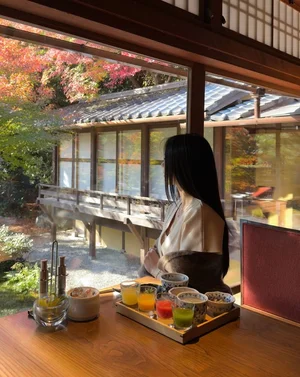
Before There Was Order, There Was Beauty
Could it be that beauty is the first language of goodness?
This thought first came to me not in glamour or grandeur, but in the ordinary quiet of this late afternoon, my dog sighing in the heat of mid-july, sunlight slipping through the linen curtains, the scent of bergamot tea rising in a room held still with the particules of dust danced in the rays of light peaking through. Waiting for the right words to come to me so I can lay them down on paper, somewhere in the silence between doing and stillness,
I found myself asking:
What if beauty is the direction?
We are taught, from quite a young age, to define our values. To gather words like discipline, duty, authenticity, family, love, and arrange them into a neat architecture of identity, like polished stones in the foundation of who we hope to become. We’re told to choose what matters. To name it and to catalog it so we can build upon it.
And yet, in all this naming, beauty is rarely treated as essential.
It often takes the face of something extra. Frivolous even. Fleeting perhaps. Feminine to the extreme, in a way that’s been subtly dismissed and dissed by cultures addicted to productivity and hyper-logic.
Beauty, they say, is nice—but not necessary—a garnish, the little green stuff on top of the main dish, but nothing close to a grounding force.
But what if beauty isn't an afterthought, but the fundamental starting point ? Imagine a world where harmony precedes all other considerations. What if form wouldn't just follow function; but would be inseparable partners?
Perhaps this challenges conventional thinking that tells us functionality is more important, but prioritising beauty from the outset could be the most evident sign of deeper innovation, spark more profound connections, and create truly enduring objects, systems, and experiences. Beauty then ceases to be the surface, and becomes the soul. In La Raza Cósmica, José Vasconcelos writes, “La estética es la madre de la ética”—Aesthetics is the mother of ethics. That lingers in you, long after the pages have been turned.
Could it be that our sense of rightness, of goodness, of excellence, is shaped not first by logic, but by what we find beautiful? By our desire to magnify it? Could it be that what we call “values” are in fact born from the internal arrangement of what compels us and what awakens some sort of reverence within us because we find it “beautiful”?
Maybe beauty should be a moral compass. In order to say so, we would be then opening the door wide open to find an adequate answer to the delicate question of what is beauty?
Because in the history of humanity, beauty took many forms, shapes, took over many industries, many places but never simply could be held in one satisfying definition … because when something was beautiful, it simply was. To some, beauty is symmetry, elegance, proportion, the measurable things. To others, it is presence, mystery, soul, the immeasurable things.
Psychologists like Dr. Nancy Etcoff, who authored "Survival of the Prettiest," explore how our attraction to beauty is not solely a cultural phenomenon, but also a biological one. Humans are wired to seek beauty as a sign of safety, health, and harmony. There is something divine and ethereal about beauty that signals to us that it is worth cultivating, aiming for, fighting for, and stopping for.
Regardless of how we try to define it, even science concedes, the more we try to pinpoint beauty, the more it shapeshifts. Because beauty, if you pause, is not just what pleases the eye, it is what awakens something within us.
Beauty somehow makes time stretch, the same way evenings fill with sunsets and laughter seem longer; it makes us want to preserve, protect, and pay attention ... and that happens every where, from nature to art to science to the mundane. Beauty is coherence and harmony of a moment and thing. Inner and outer. Felt, even when not fully understood.
And perhaps most mysteriously … it’s not always something we see, at times it cannot even be observed. It’s something we sense. Which makes the question of what beauty is even more delicate because beauty is also the right words at the right time. The way someone listens. The mesmerising force of the arc of a wave folding back into the sea. The light shimmering gently on your skin accompanied with its warmth. The loving energy between two lovers. The silence that eases night into morning. But one thing appears to be true … we know beauty when we meet it.
Which brings me to the question I often ask myself ... as a woman, as a founder, as a, as I like to call it, steward of the aesthetic, as someone who takes beauty very seriously:
How does one make beauty a priority, without becoming obsessed with appearance?
The first thing anyone must be able to admit is that true beauty is not perfection—it’s precision.
And precision in any case comes when the inside matches the outside. When our environments, our brands, our rituals, our wardrobe, our calendars, our conversations, our prayers, our desires, our makeup, our thoughts, even our conversations become expressions of care and clarity.
As women, particularly as feminine founders, we are often the magnifiers of beauty in the spaces we inhabit. We set the tone. We polish the rough edges. We notice the subtleties that make people feel safe, seen, and inspired. It is our greatest gift, our duty even. But we’ve also been trained to externalise this role. To perform beauty, rather than be abundant in it, rather than embody it from within. To focus on appearances rather than deep alignment with it. From the way we are taught to put on makeup to seduce, to dress to please, to speak to appease, we are sculpted by what is theoretically beautiful, and we grow performing an idea of beauty that perhaps is not always true. And this is where obsession takes root, when beauty becomes something we chase, not something we cultivate.
To prioritise beauty is not to decorate your life. It is not to buy the latest trends or to make your home worthy of Living magazine. To have beauty is to devote yourself to harmony. In your body. In your brand. In your boundaries. In your beliefs. In your relationship with yourself as well as with others. When beauty is aligned with truth, it becomes sacred. When divorced from truth, it becomes a performance. That is the line we walk. And that is where aesthetic becomes ethical.
This is why we make it a point to make B0LD beautiful, to have beauty is not just a “pillar”, it is our pulse. We design slowly. Strategically. With heart. We speak of your projects like they were our own. We take your vision as sacred. Our work is about ripples & layers. About how the story feels in the body before the brain has had time to dissect it.
Because here is something most marketing schools don’t teach: The nervous system responds to beauty.
The late Dr. Stephen Porges, founder of Polyvagal Theory, explained that the human nervous system is constantly scanning for cues of safety—or threat. Beauty, when sincere, is a cue of coherence, and cognitively, it becomes appealing, because somehow, it makes sense to us. This is why Loewe is experiencing a second boom in trendiness, although it is following a new misunderstood hectic style and marketing, the creative direction is about creating something beautiful, unapologetically. This is why a well-designed space brings peace. Why a lovingly written email feels like a relief in our day. Why an aligned visual identity isn’t just “on-brand” … it’s magnetic. Because we feel the integrity before we can articulate it.
So yes, beauty belongs in business. And as women, especially those of us who lead softly but powerfully, we must reclaim the wisdom of beauty not as frivolity, but as our frequency. A vibrational standard for our work and our lives.
There is one last layer. To reclaim it is to live it but how do we live beautifully, without performing beauty?
To live beautifully is to move with honour a life well-lived. To tell the truth, even when it’s inconvenient. To curate what you consume, not only in your home, but in your mind, in your body. To know what is enough. To honour silence. To dress in a way that reflects your essence, not the algorithm. To make decisions from devotion, not dopamine.
So perhaps the question is not what is beauty?
But rather,
When beauty leads, what possibilities emerge?
What kind of business takes shape when resonance outweighs reach?
What kind of love is invited in when presence is chosen over performance?
What kind of life unfolds when you cease adorning your pain and commit yourself to peace?
What do you attract when your standard is sacred?
I’ve come to believe that beauty, in its truest form, is not found in mirrors or magazines or how much we end up having success on certain campaigns, but in every tiny little moment. In the way we write to our clients. In the way we water the basil and pet the dog. In the way we wash the dishes with warm soapy water at night. In the gentle refusal to rush. In the decision to live like we actually mean it.
My perennial question often was, how does one manage that? How do you live life like such?
The notion of "being present" has become a pervasive cliché, one that is overused, over-preached to the point of losing its impact. And yet … yet despite its trite familiarity, it remains the singular most important answer to the fundamental question: "How does one integrate beauty as a core value into their life, thereby living a truly beautiful existence?"
To make a deliberate return to the 'what is', to the current moment. Within this immediate experience, one cultivates the ability to discern and appreciate beauty, however subtle or grand. If you think about it, it is not quite passive observation; it's an active engagement with the present, seeking out and recognising what often goes unnoticed in the rush of daily life.
Furthermore, once beauty is perceived, the next step is to find innovative and intentional ways to magnify it. This could involve consciously savoring a sensory experience, creating an environment that fosters peace and visual pleasure, or engaging in activities that bring a profound sense of connection and wonder. It is through this dual process – the discovery of beauty and its subsequent amplification – that one can truly harness the power of the present moment.
This simple yet profound principle serves as the only genuine, actionable tip for making the absolute most of the current moment and the task at hand. By grounding oneself in the immediacy of experience, actively seeking out beauty, and consciously enhancing its presence, life transforms from a mere sequence of events into a rich tapestry woven with moments of profound appreciation and enduring splendor.