ELLE- the new series, the lessons
Editorial Series | Feminine Power | The Weapon Wore Pink
July 13, 2026 | The Icons Series Summer Editorial Series | Focus: "Why we fell for Elle Woods all over again — and what she knows about positioning that we forgot"
Something happened in living rooms this month that the culture has not fully reckoned with. Twenty-five years after a blonde in a sorority sweater talked her way into Harvard Law, we hit play on a pink television show about a teenage girl in 1995 Seattle — and a great many of us, cynical and exhausted and thoroughly flattened by an internet full of the same beige competence, felt something we had not felt in a while. We felt relief.
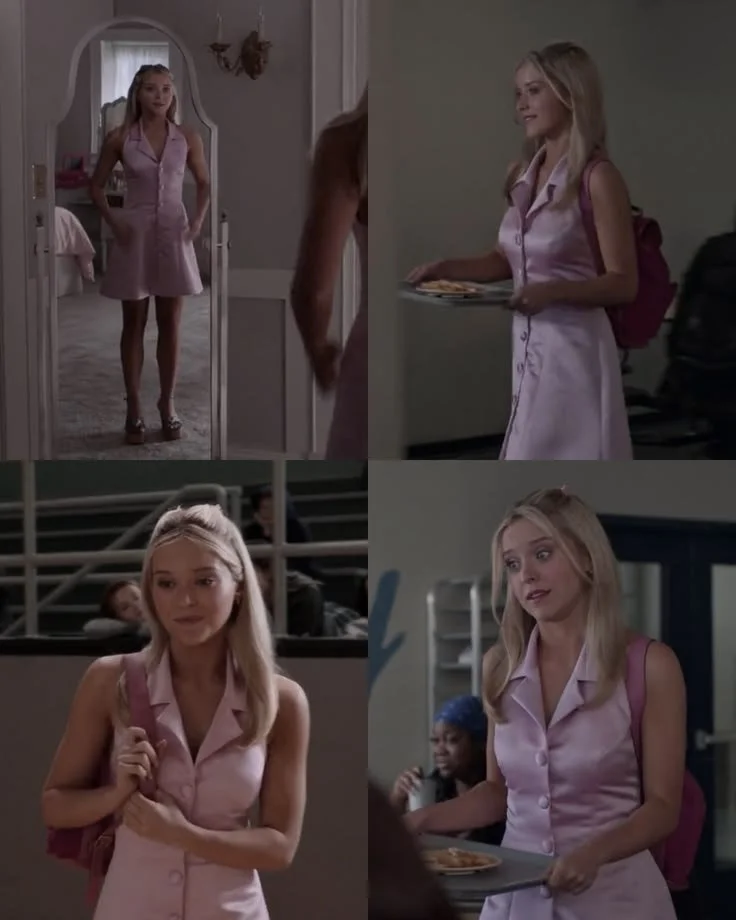
Prime Video's Elle — the prequel that drops us into Elle Woods's high school years, before the pink Harvard admissions video, before "what, like it's hard?" became a generation's private mantra — is on its surface a nostalgia play, an origin story for an icon, an eight-episode return to a character Reese Witherspoon has spent a quarter century turning into a franchise and, not incidentally, a media empire. But I do not think nostalgia explains the ache. We are not just remembering Elle. We are needing her, now, specifically, in a way that says more about this cultural moment than about the show.
So let me ask the question this series exists to ask: why are we in love with her again? Not as fans. As strategists. Because underneath the pink, Elle Woods is running the most sophisticated positioning play in popular culture, and we have never needed her lesson more than we do in the summer of 2026.
The choice she refuses to make
Here is the contradiction Elle resolves that the rest of us, twenty-five years later, still cannot.
The culture continues to hand women a false binary and call it realism. Be feminine or be taken seriously. Be soft or be powerful. Be liked or be respected. Be the woman in pink or the woman in the room where decisions are made — but understand, dear, that you cannot be both, and the sooner you pick, the sooner we can take you seriously. This is offered as mentorship. It functions as a cage. And every woman who has ever muted her own warmth to seem competent, flattened her own delight to seem serious, or swapped the color she loved for a "professional" grey has paid its tax.
Elle Woods walks into that binary and detonates it. She does not become less feminine to win. She wins through her femininity — the aesthetic literacy, the emotional intelligence, the ferocious attention to detail that the world had dismissed as vanity right up until the moment it turned out to be genius. She keeps the pink. She keeps the joy. She keeps the whole self the establishment told her to file down, and she wins anyway, and that — not the courtroom victory, not the romance — is the fantasy we cannot stop rewatching. She is proof of a thing we were told was impossible. She is permission, wearing heels.
The prequel sharpens this to a point, because it shows us the becoming. We meet her before the armor is fully assembled — a girl uprooted from sunny Beverly Hills to grey Seattle, learning in real time that the world will underestimate her and deciding, stone by stone, not to shrink to fit its estimate. De Beauvoir told us one is not born but rather becomes a woman; the show is that sentence rendered as television. We are watching an identity get built. And there is nothing more compelling to a culture drowning in ready-made, AI-averaged sameness than the sight of a person deliberately constructing a self that refuses the average.
The genius of being underestimated
Now let me put on the psychologist's glasses, because the mechanism beneath Elle's power is one every founder should study.
There is a well-documented bias — call it the beauty-as-frivolity heuristic — in which visible femininity, prettiness, pinkness, warmth itself get read by the brain as evidence of a lack: less serious, less rigorous, less capable. It is the horns to competence's halo. And it is a stupid bias, demonstrably, expensively stupid — but here is what Elle understands that her detractors never do: a wrong estimate of you is not only an insult. It is a position. When the room decides in advance that you are not a threat, it lowers its guard. It stops watching you the way it watches the people it fears. And into that lowered guard, the underestimated woman walks with everything she needs and half the resistance everyone else faces.
Elle does not correct the misread. She uses it. She lets the world file her under "harmless" and then does her homework, and the gap between the expectation and the reality is where all her power lives. Social psychologists call it expectancy violation — we remember, vividly, the person who shatters the box we put them in, far more than the person who merely meets our expectations. The isolation effect I have written about before, wearing lip gloss. Elle is unforgettable precisely because she was supposed to be dismissible. The dismissal was the setup. The victory was the punchline. And the whole culture leans forward, every time, for the moment the box breaks.
There is a Jungian layer here too, and it is the deepest one. The "bimbo" is a persona — a mask the world projects onto her, not a self she inhabits. Most people, handed a persona that convenient and that limiting, either fight it exhaustingly or collapse into it. Elle does neither. She lets the persona sit on the surface, undisturbed, while the actual Self operates underneath it, fully intact, entirely hers. She has separated who she is from who she is assumed to be, and she guards the distance between them like a strategist guards a secret. That is not naivety. That is the most advanced self-possession there is.
Elle Woods as a positioning masterclass
Strip away the story and look at what she is actually doing, and it is a clinic in everything this series has been arguing all summer.
She owns an axis no one else will touch. Unapologetic femininity plus intellectual rigor — a combination the world insisted was a contradiction, which is exactly why it was available. Everyone else was busy choosing one or the other. Elle took the territory both camps abandoned and became a category of one. That is distinction in its purest form: not being better on a crowded axis, but being the only one standing on an axis everyone else was too afraid to claim.
Her aesthetic is not decoration — it is the argument. The pink, the presentation, the immaculate curation of everything: this is taste deployed as intelligence, aesthetic literacy as a form of capital the establishment refuses to recognize until it is beating them in court. Bourdieu would recognize instantly what the show understands intuitively — that taste is a kind of power, and a woman fluent in it possesses a fluency her dismissers cannot even perceive, let alone counter.
Her optimism is a strategic weapon, not a personality quirk. In a culture that codes cynicism as intelligence and earnestness as embarrassing, Elle's refusal of bitterness is quietly radical. She is nice — genuinely, unironically warm — and she is lethal, and the combination breaks the brain of everyone who was taught those two things cannot coexist. Her joy is not the absence of edge. It is the disguise of it, and increasingly, in a flattened and exhausted internet, the sheer differentiating force of it.
Every woman building anything can steal this: the position no one is defending, the aesthetic that is secretly your rigor, the warmth that is secretly your weapon, and the low expectation you can choose to weaponize instead of resent.
Why now
The timing is not an accident, and it is worth reading like a signal.
We are living through the great flattening — a culture where the machines produce infinite competent sameness, where every brand and every feed has optimized itself into the same beige fog, where "slop" became a word of the year because so much of what we consume now trends toward the median. And into that grey, Prime Video drops a defiantly, aggressively pink origin story about a girl who refuses to be averaged. Of course we are in love with her. She is the antidote to the exact thing that is exhausting us. She is specificity in a season of sameness, joy in a season of cynicism, a whole vivid self in a season of algorithmic beige.
There is a meta-lesson sitting right on top of the show, and it is the shrewdest part of all. The woman who built this — who turned one pink movie into a prequel, a franchise, and a production empire — did it by making a bet the industry found laughable: that stories centered on women, their interiority and their ambition, were not a niche but a market others had criminally under-served. She positioned an entire company on the territory everyone else abandoned. She built a category of one out of the audience the establishment underestimated. Elle Woods is not just the character. She is the business model. The origin story of the icon is also, if you squint, the origin story of how you position a company by taking seriously exactly what the room dismissed.
The bridge
This is the entire thesis I build businesses on, and Elle Woods has been teaching it in heels since before I had the vocabulary for it: femininity is not the thing you overcome to be taken seriously. It is, deployed with strategy, the thing that makes you unignorable. The warmth, the taste, the joy, the refusal to file yourself down — these are not liabilities to be managed on the way to power. They are the position itself.
Finding that position — the axis where your dismissed quality becomes your defining strength — is the spine of the Strategic Positioning Audit. And learning to build from your femininity rather than in spite of it, to run a company and a life with the ease the world insists is incompatible with ambition, is exactly what Feminine Flow in Business exists to teach. The women in the community are the ones who stopped apologizing for the pink and started using it. Because the market, like every underestimator Elle ever faced, is about to learn what the underestimated always eventually teach.
Closing reflection
We are in love with Elle Woods again because she is proof of the thing we were promised was a lie: that you do not have to become someone smaller, greyer, or more palatable to win. That the self they told you to hide can be the self that wins. That the pink was never the weakness — it was the weapon, and the only mistake was ever believing the people who told you to take it off.
The prequel shows us the girl before she knew all this, learning it the way we all have to — through being underestimated, uprooted, dismissed, and deciding, against every incentive, to stay entirely herself anyway. That is why the pink television show made a flattened culture exhale. It reminded us that the most radical strategic act available to a woman is still, twenty-five years later, the simple refusal to disappear into the expectation.
So here is the question I would leave you holding, in whatever grey room told you to tone it down:
What is the pink they told you to take off — and what would happen if you finally understood it was the weapon all along?
Wear it. Do your homework. And let them keep underestimating you right up until the verdict.
B0LD is a cultural intelligence agency disguised as a marketing firm. We help women position from their strength instead of apologizing for it. Find the axis where your dismissed quality becomes your edge with the Strategic Positioning Audit, or begin with Feminine Flow in Business.
SEO keywords: Elle Legally Blonde prequel, Elle Woods, Legally Blonde Prime Video series, femininity in business, female founder branding, women underestimated in business, feminine power strategy, personal branding for women, Elle Woods branding lessons, feminine positioning.