12 Questions to Ask a Branding Agency Before You Sign (Canada)
Editorial Series | Brand Strategy, Canada | 12 Questions Before You Sign
description: The hiring checklist Canadian founders need: 12 questions to ask a branding agency about scope, process, copyright, trademarks, French and life after launch, plus what good and bad answers sound like. Target keyword: questions to ask a branding agency, branding agency interview questions, hiring a branding agency checklist, branding agency contract Canada, branding agency Canada
The Room After the Pitch: 12 Questions to Ask a Branding Agency Before You Sign
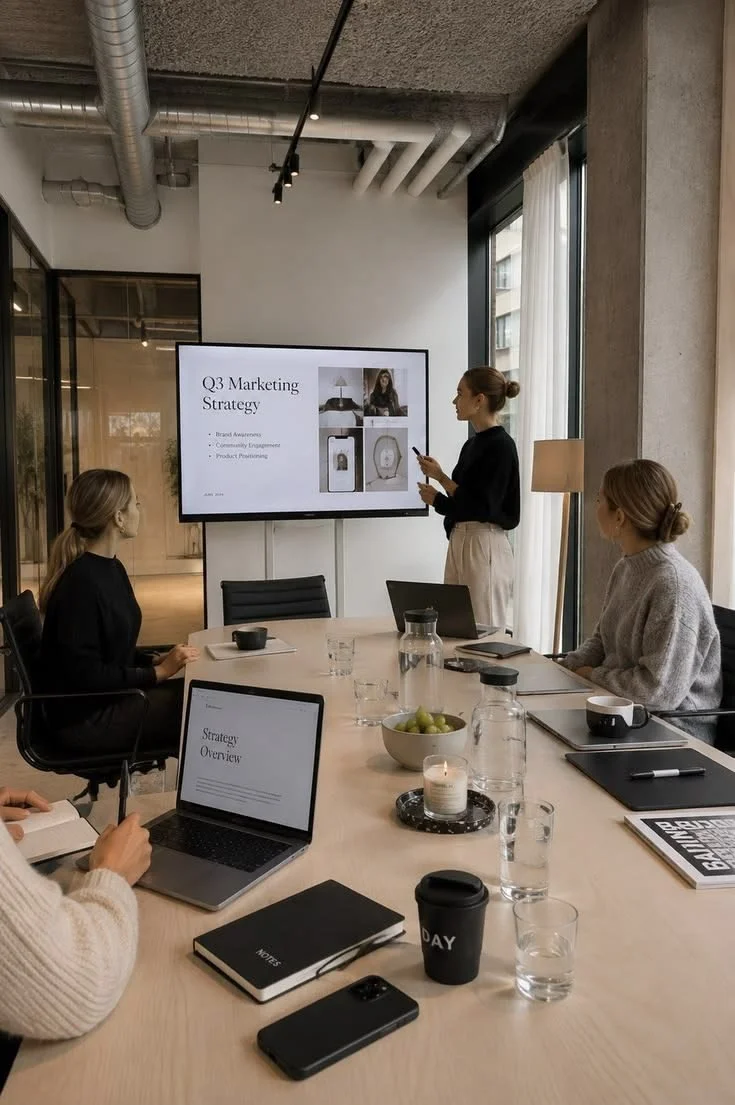
The questions to ask a branding agency before you sign are the ones that test the contract, not the charm: what the agency thinks your real problem is, what is in and out of scope, how many directions you will see, how revisions and payments work, who owns the copyright, whether the name can be trademarked, how French and other languages will be handled, and what you keep after launch. In Canada, two answers matter more than most founders realize: under the Copyright Act the designer owns the work unless it is assigned to you in writing, and moral rights can be waived but never assigned.
The pitch went beautifully. That is the problem.
You know this meeting. The agency founder is brilliant, and the deck has your company's name set in a typeface you instantly want. Someone says "we'd love to partner with you," and it sounds like a promise rather than a sales line. You leave warm, a little flattered, almost ready to sign.
That warmth is real. It is also the least reliable signal in the process. A pitch is rehearsed. The contract is not, and it is where you will live for the next six months.
This article is the companion checklist to our guide to the best brand strategy firms in Canada. That guide helps you decide which type of firm fits your problem, and it already covers the four questions that reveal character: what the firm is not good at, who will actually do the work, what its own positioning looks like, and how it reports. This piece starts where that one ends. You have a shortlist. You have two or three proposals. Here are the twelve questions to ask before your signature turns a nice feeling into a binding agreement.
Bring them to the second meeting, not the first. The first meeting is for chemistry. The second is for honesty.
Before the branding agency interview: what you should know yourself
An interview only works if you know what you are listening for. Before you ask an agency anything, write down three things on a single page.
The problem in one sentence. Not "we need a rebrand," but "premium customers think we're a mid-market brand, and we keep discounting to close." An agency can only solve a problem you are willing to name.
The budget range you will actually spend. If you have not set one, our guide to how much branding costs in Canada gives sourced ranges in Canadian dollars and the line items (sales tax, trademark fees, French adaptation) that rarely show up on the first quote.
The decision-maker. If a co-founder, investor or board will veto the final direction, they need to be in the process from the beginning, not brought in at the presentation. More good branding has been killed by a late opinion than by a bad idea.
Questions 1 to 4: scope and thinking
1. "After this conversation, what do you think our real problem is?"
This is the most revealing question you can ask a branding agency, and most founders never ask it. You are not looking for a full diagnosis after one call. That would be a bluff. You are looking for a hypothesis, said plainly, that shows they listened. A strong answer sounds like: "I suspect the product is ahead of the story. Your customers are buying the quality but don't have the language to repeat it." A weak answer repeats your brief back to you in nicer words.
2. "What exactly is in scope, and what is not?"
Ask for a written list of deliverables, and then ask for the list of what is excluded. The second list matters more. Website build, packaging production files, photography, copywriting beyond the core messages, social templates, translation: each of these is in some proposals and absent from others. If the word "strategy" appears without a description of what it produces, ask what you will be holding at the end of that phase.
3. "What will you need from us, and how much of my time?"
Good branding is not done to you. It is done with you. A serious agency will tell you how many hours a week it needs from you and when. If the answer is "hardly any," either the process is shallow or someone will be guessing on your behalf.
4. "What does discovery include, and who will you talk to?"
Discovery is where an agency earns its fee or fakes it. Ask whether it includes customer interviews, a competitive audit, cultural or category research, and conversations with your team. Ask what the output of discovery is, and whether you will see it before any design begins. If the first deliverable is a logo, there was no discovery. There was a mood.
Questions 5 to 8: process, proof and payment
5. "How many creative directions will you develop, and why that number?"
One direction is a recommendation. Three directions is an exploration. Neither is wrong, but they are different products at different prices, and you should know which you are buying.
Here is an example from our own studio. For one restaurant in Monterrey, B0LD wrote three complete brand worlds. The client chose another one. One of the directions left on the table was Espina, a taquería world we now show as Hors série: alternate ending. It had a moodboard of nine images, a name that meant both thorn and backbone, a pencil-drawn wordmark, a palette of linen, midnight navy and saddle brown, and a symbol drawn from a cactus spine that up close looks like a star: an oval seal with two ribs and three eight-pointed stars. It reached all the way to embroidered navy napkins, a debossed textured menu, and staff in rounded collars and knit ties.
Three is not a magic number. The point is that the client could feel distinct futures before committing. Ask how far each direction will be developed. A name and a palette is a sketch. Napkins and a menu are a world.
6. "Can I speak to a client whose project was difficult?"
Every agency has a happy reference. Ask for the one where something went wrong: a missed deadline, a rejected direction, a scope that grew. How they handled it tells you more than any case study.
7. "How are revisions, approvals and scope changes handled?"
"Unlimited revisions" sounds generous and usually signals a process with no point of view. Look for a defined number of revision rounds at each stage, a clear sign-off moment, and a written change-order process with a price attached. The goal is not to be stingy with feedback. It is to make sure that a change in month four is a decision, not a drift.
8. "What is the payment schedule, and what happens if either of us walks away?"
Ask how the fee is split (deposit, milestones, final payment), which currency you will be billed in, and whether sales tax is included in the quote. Then ask the uncomfortable part: if the relationship ends halfway, what do you pay, and what do you keep? A kill fee tied to completed work is fair. A contract that leaves you paying in full with nothing to show is not.
Questions 9 to 12: the Canadian contract questions most checklists skip
Most checklists for hiring a branding agency on Google's first page come from UK or US agencies, and they share a blind spot: the contract. For a Canadian brand, these four questions are where the risk lives.
9. "Will you assign the copyright to us in writing, and waive moral rights?"
This is the question most founders assume is handled and most often isn't. Under Canada's Copyright Act, "the author of a work shall be the first owner of the copyright therein." If an outside agency or freelancer designs your logo, they own it unless they transfer it, and the Act says no assignment is valid "unless it is in writing signed by the owner."
Then there are moral rights: the author's right to be associated with the work and to object to changes that harm their reputation. The Act is clear that moral rights "may not be assigned but may be waived in whole or in part." A strong branding contract therefore includes two separate things: a written assignment of copyright in the final deliverables, effective on payment, and a written waiver of moral rights from everyone who worked on them, including subcontractors. Ask too who owns the source files and the directions you did not choose. This is not legal advice. Have a lawyer read the IP clause. But ask the question before the lawyer has to.
10. "Will you screen the name and mark so we can actually protect them?"
A name you cannot register is a name you are renting. A responsible agency screens candidate names early, before you fall in love with one, and tells you plainly when a trademark agent or lawyer needs to run a proper clearance search. The filing itself goes through the Canadian Intellectual Property Office. CIPO's official schedule lists the 2026 online filing fee at CAD$491.06 for the first class of goods or services and CAD$149.04 for each additional class, with certain fees rising 1.7% on January 1, 2027. The agency does not need to file for you. It does need to design with protection in mind.
11. "How will you handle French, and every other language we sell in?"
If you sell in Québec, French is not a translation step at the end. The Charter of the French Language affects how your brand appears on packaging, signage, websites and commercial materials, and recent amendments under Bill 96 have tightened the rules. Our separate guide to Bill 96 and your brand covers what Québec's French-language requirements mean in practice.
The interview question is simple: will this brand be conceived in both languages, or written in English and translated afterwards? A tagline that sings in English and limps in French is a brand that works in half the country. The same applies if the United States or Mexico is on your roadmap. Spanish, too, is a culture, not a dictionary. Ask who on the team writes natively in each language, by name.
12. "What do we walk away with, and what does life after launch look like?"
Ask for the handover list: brand guidelines, master files in every format, fonts and licences, templates, and the strategic documents behind the design. Check font licensing in particular; a typeface licensed to the agency is not automatically licensed to you. Then ask about the first ninety days after launch. Who checks that the packaging printer, the web developer and your new marketing hire are applying the brand correctly? A brand fails more often in rollout than in the studio.
A note on free pitches and spec work
At some point you may be tempted to ask three agencies to "show us some ideas" before you choose. It feels efficient, and it is worth knowing how the Canadian design profession sees it. The Association of Registered Graphic Designers (RGD) defines spec work as "providing design work for free (or for a nominal fee) as part of a pitch for new business," and its Code of Ethics prohibits members from doing it.
RGD's guidance for clients is practical: issue a clear brief or request for proposal and choose on process, team, relevant work and references, or, if you really need to see creative ideas first, pay each firm a fee that reflects a reasonable design fee for the work. Free concepts are made without discovery, to win a room. They tell you who pitches well, not who thinks well.
Hiring a branding agency checklist: what good and bad answers sound like
Print this, or keep it open beside the proposal.
Question A strong answer sounds like A red flag sounds like 1. Our real problem A clear, modest hypothesis they will test Your brief read back to you 2. Scope Written deliverables and written exclusions "Strategy" with no defined output 3. Your time Hours per week, by phase "Hardly any, we'll handle it" 4. Discovery Interviews, audit, research, shared before design Logo concepts in week one 5. Directions A number, and how far each is developed "As many as you need" 6. Difficult reference A real story, told candidly "All our clients are thrilled" 7. Revisions Set rounds, sign-offs, priced change orders "Unlimited revisions" 8. Payment and exit Milestones, currency, tax, fair kill fee Full fee due regardless of output 9. Copyright Written assignment and moral-rights waiver "You'll own it, don't worry" 10. Trademark Early screening, referral for clearance "Just Google it" 11. Languages Native writers, named, from day one "We'll translate it at the end" 12. Handover Files, fonts, guides, rollout support A PDF and a goodbye
For the women hiring a branding agency: ask the second question
A word for the women reading this, because the hiring room can feel different from where you sit.
Many women founders were taught, explicitly or not, that pressing hard questions in a warm meeting is rude, and that a good relationship should not need clauses. So you ask the first question politely, accept the first answer graciously, and save your doubts for the drive home.
Here is the reframe. Asking the second question is not suspicion. It is respect, for the agency and for your company. The best agencies want the client who asks who owns the source files, because that client will also give clear feedback, protect the brand after launch, and pay on time. The agency that bristles at question nine is telling you, early and cheaply, how it will behave in month five.
Elegance in business is not the absence of hard questions. It is asking them without apologizing. You can be warm and exact in the same sentence: "I love this direction. Before we go further, walk me through the IP clause." That is not a woman being difficult. That is a CEO doing her job.
Where B0LD fits, and how to get a second opinion before you sign
In the spirit of this checklist, here are our own answers, plainly. B0LD is a bilingual boutique brand-positioning agency with Canadian roots, working in English, Spanish and French across Canada, the United States and Mexico. Our founder is a published Québec playwright who built her first business in Québec, and she leads every engagement personally. There are no hand-offs, so the person in the pitch is the person doing the work.
We are the right fit for founder-led premium, wellness, luxury, hospitality and cross-border brands that are excellent and still misunderstood. We are the wrong fit if you need a logo by Friday or a content factory, and we would rather say so in the first meeting than the fifth.
You do not have to hire us to use us well:
Holding a proposal and want a senior read before you sign? Book a 1:1 Consultation ($800). Bring the proposal and this list. We will go through scope, directions, IP language and language strategy with you, whoever you end up hiring.
Not sure the problem is branding at all? The Strategic Positioning Audit ($3,500) is a bounded, senior diagnostic of your position before you commit to a full engagement with anyone.
Comparing firms? Start with our guide to Canada's top brand strategy firms, then explore b0ld.ca and the blog.
Want to think it through with other founders? Join the B0LD Skool community.
The pitch will still be beautiful next week. Your signature will mean more once you know what you are signing.
FAQ: questions to ask a branding agency
What are the most important questions to ask a branding agency? Ask what they think your real problem is, what is in and out of scope, how many directions they will develop, how revisions and payments work, who owns the copyright, whether the name can be trademarked, how they handle each language you sell in, and what you receive at handover. In Canada, the copyright and French-language questions deserve particular attention.
Who owns the logo when I hire a branding agency in Canada? By default, under the Copyright Act, the author is the first owner of the copyright. You own it only if it is assigned to you in writing and signed. Moral rights cannot be assigned but can be waived, so your contract should include both an assignment and a waiver. This is not legal advice; have a lawyer review the clause.
Should I ask branding agencies to pitch ideas for free? The Association of Registered Graphic Designers prohibits its members from doing spec work. It suggests choosing on process, team, relevant work and references, or paying each firm a reasonable fee if you need to see creative concepts first.
How many branding agencies should I interview? There is no fixed rule, but two or three serious finalists is usually enough to compare scope, process and contract terms properly. More than that tends to turn the decision into a beauty contest.
What should be in a branding agency contract? At minimum: written deliverables and exclusions, a timeline, revision rounds, a change-order process, a payment schedule with currency and tax, termination terms, a copyright assignment, a moral-rights waiver, and a handover list including source files and font licences.